
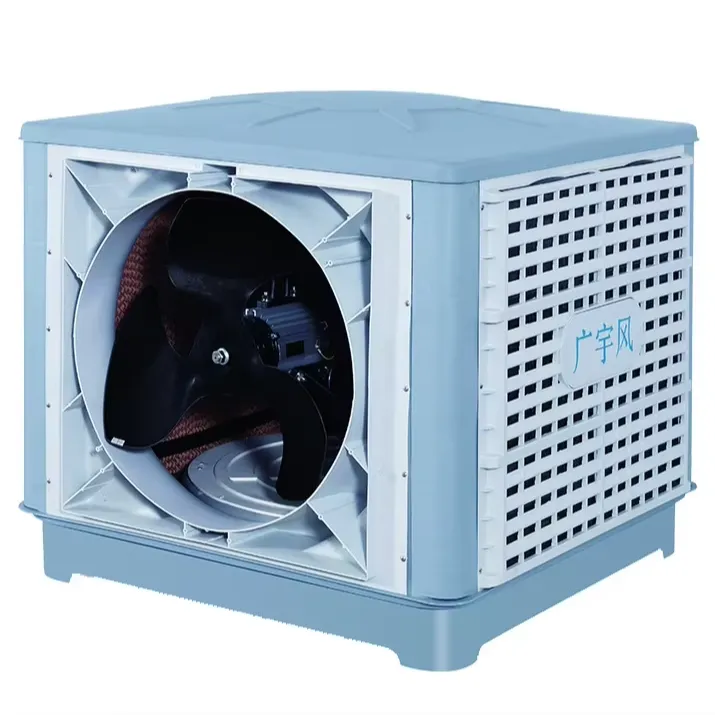


Industrial Air coolers: The Complete Guide to Energy-Efficient Cooling Solutions for Large Spaces
Industrial air coolers have become one of the most effective and energy-efficient cooling solutions for large-scale environments such as factories, warehouses, workshops, agricultural facilities, and commercial spaces. As global temperatures rise and energy costs increase, businesses are actively seeking alternatives to traditional air conditioning systems that can deliver strong cooling performance with lower operational costs.
Unlike conventional air conditioners that rely on refrigerants and sealed systems, industrial air coolers use the natural process of evaporative cooling to reduce air temperature. This method not only consumes significantly less energy but also provides continuous fresh air, making it particularly suitable for open or semi-open environments.
Industrial air coolers are widely recognized for their ability to improve air circulation, enhance worker comfort, and maintain stable environmental conditions without the high energy demands of traditional HVAC systems. With advancements in technology, modern air coolers are becoming more efficient, durable, and adaptable to different industrial needs.
Industrial air coolers are high-capacity cooling devices designed to lower air temperature using the process of water evaporation. These systems draw in warm air, pass it through water-saturated cooling pads, and release cooler air into the environment.
Unlike air conditioning systems, industrial air coolers do not use compressors or refrigerants. Instead, they rely on a combination of airflow, water evaporation, and heat exchange to achieve cooling. This makes them more energy-efficient and environmentally friendly.
Industrial air coolers are available in various configurations, including fixed installations, ducted systems, and portable units. They are commonly used in environments where traditional air conditioning is impractical or too costly.
These systems are also known as evaporative air coolers, swamp coolers, or industrial evaporative cooling systems.
The working principle of industrial air coolers is based on evaporative cooling. When water evaporates, it absorbs heat from the surrounding air, resulting in a temperature drop.
The process begins when warm air is drawn into the cooler by a powerful fan. The air passes through cooling pads that are kept wet by a water distribution system. As the air flows through the pads, water evaporates and absorbs heat from the air.
The cooled air is then blown into the space, creating a refreshing and comfortable environment. At the same time, fresh air continuously enters the system, improving ventilation.
This process is highly energy-efficient because it does not require compressors or refrigerants. It also provides constant air exchange, reducing the buildup of heat and pollutants.
Industrial air coolers consist of several key components that work together to deliver efficient cooling.
The fan system is responsible for moving large volumes of air. High-performance motors ensure strong airflow and wide coverage.
Cooling pads are essential for the evaporation process. They are designed to maximize water absorption and airflow efficiency.
The water system includes a tank, pump, and distribution network that keeps the cooling pads wet.
The housing structure is built with durable materials to withstand industrial environments.
Control systems allow users to adjust fan speed, water flow, and cooling levels.
Industrial air coolers are designed with features that make them suitable for large-scale applications.
High airflow capacity ensures effective cooling in large spaces.
Energy efficiency is a major advantage, with significantly lower power consumption compared to air conditioners.
Eco-friendly operation eliminates the need for chemical refrigerants.
Fresh air ventilation improves indoor air quality.
Flexible installation options allow for different configurations.
Low maintenance requirements make them cost-effective.
Industrial air coolers offer numerous benefits for businesses.
One of the primary advantages is reduced energy consumption, leading to lower electricity costs.
Another benefit is improved air quality. Continuous airflow removes dust, odors, and pollutants.
Worker comfort is significantly enhanced, improving productivity.
These systems are ideal for open spaces where traditional air conditioning is not effective.
They also provide a sustainable cooling solution with minimal environmental impact.
Industrial air coolers are widely used across various industries.
Factories use them to cool production areas and improve working conditions.
Warehouses benefit from better airflow and temperature control.
Agricultural facilities use them for livestock and crop environments.
Workshops and assembly lines rely on them for localized cooling.
Commercial spaces such as markets and event venues use them for comfort.
There are several types of industrial air coolers.
Portable air coolers offer mobility and flexibility.
Fixed air coolers are installed in specific locations.
Ducted systems distribute cooled air through ducts.
Window-mounted units are used in smaller spaces.
Roof-mounted systems provide large-scale cooling.
Industrial air coolers differ from traditional air conditioning systems.
They use water evaporation instead of refrigerants.
Energy consumption is significantly lower.
They provide fresh air instead of recirculating indoor air.
However, their effectiveness depends on humidity levels.
Energy efficiency is one of the biggest advantages of industrial air coolers.
They use simple components that consume less power.
Water usage is relatively low.
Eco-friendly design reduces carbon footprint.
These systems support sustainability goals.
Selecting the right system requires careful consideration.
Cooling capacity should match the space size.
Airflow rate determines coverage area.
Water tank size affects operation time.
Installation requirements should be evaluated.
Climate conditions should be considered.
Regular maintenance ensures optimal performance.
Cooling pads should be cleaned or replaced.
Water systems should be maintained.
Fans and motors should be inspected.
Proper water quality improves efficiency.
The future of industrial air cooling focuses on innovation and sustainability.
Smart control systems are becoming more common.
Improved materials enhance efficiency.
Hybrid systems combine different cooling technologies.
Energy efficiency continues to improve.
Industrial air coolers are an efficient, cost-effective, and environmentally friendly solution for large-scale cooling needs. They provide strong airflow, fresh air ventilation, and significant energy savings, making them ideal for a wide range of industrial and commercial applications.
As industries continue to seek sustainable and economical cooling solutions, industrial air coolers will play an increasingly important role in modern climate control systems.




Copyright @ Guangdong Guangyu Wind Ventilation and Cooling Equipment Co., Ltd All rights reserved Main products: Industrial ceiling fans, sourced from the factory
SitemapThis website uses cookies to ensure you get the best experience on our website.

 Español
 한국어
한국어 العربية
 বাংলা
বাংলা



 WhatsApp
 Phone
Phone